



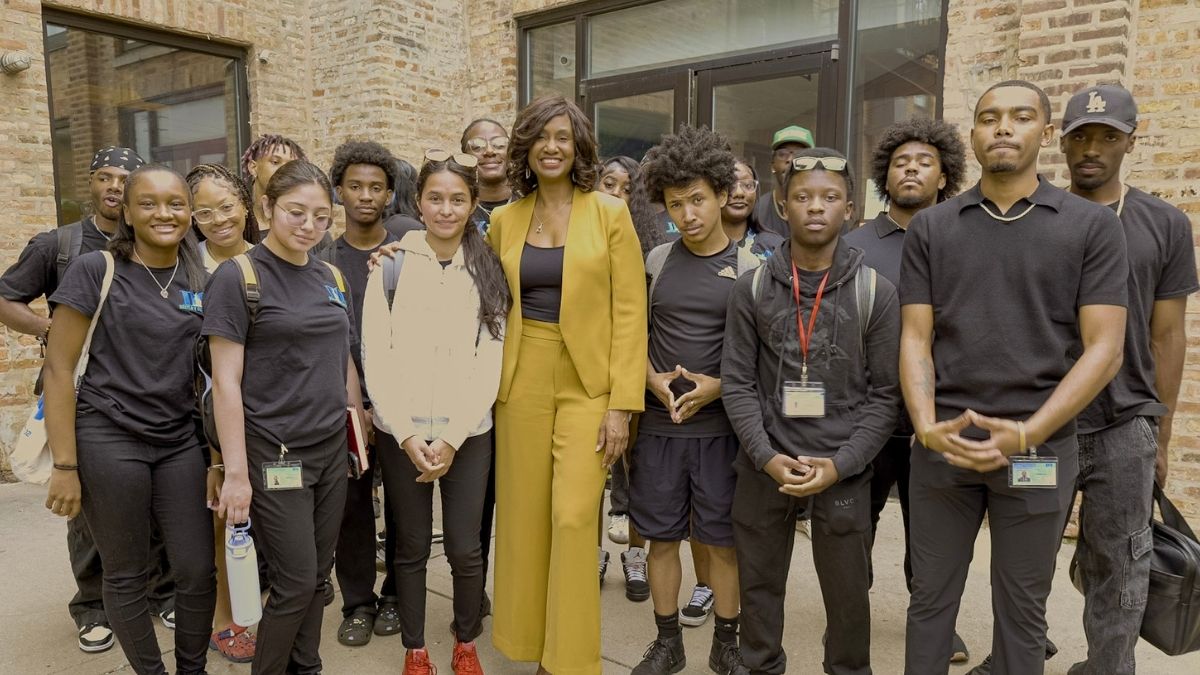

Danita Patterson Brings Hollywood Experience Home, Opening Entertainment Doors for Chicago Youth (Chicago, IL) — When Hollywood producer Danita Patterson left Chicago for Los Angeles in her early 20s, it was not because she wanted to leave her hometown behind. She left because the television and film career she wanted was difficult to build here.
Years later, Patterson has returned with a goal that is both personal and ambitious: helping ensure the next generation of Chicago talent does not have to leave the city simply to find a way into the entertainment industry.
“I probably would not have left Chicago if I could have done what I was doing in Los Angeles — narrative TV and film projects — if I could have done it in Chicago,” Patterson said in an interview. “I think it was always in my heart” to eventually pay that opportunity forward.
That idea has taken shape through Destiny Outreach’s “Dreams & Destiny” Entertainment Industry Apprenticeship Program, an initiative that has provided 80 paid apprenticeships to young people ages 16 to 24 during its pilot year.
On Sunday, Sept. 13, Destiny Outreach is marking that milestone with the graduation of Cohorts 3 and 4 at the Claudia Cassidy Theater inside the Chicago Cultural Center. The ceremony caps a first year that grew from an experimental workforce program into an extended initiative connecting young people with production companies, studios, unions and entertainment professionals across the Chicago area.
For Patterson, however, the program is about more than creating another internship.
It is about access.
“Chicago is one of the most talented cities in the United States,” Patterson said. “Talent is not the issue. Access.”
She said relationships and preparation are often the difference between someone who wants an entertainment career and someone who actually gets an opportunity to build one. The industry can operate almost like a “secret society,” she said, where knowing how a professional production works — and knowing people already inside it — can dramatically change a young person’s trajectory.
From production assistant to producer
Patterson understands that path firsthand.
Before building a career as a producer, she started as a production assistant, carrying a clipboard, following producers and taking on whatever assignments were needed. Her early Chicago experience included work around the Stellar Awards, “Windy City Celebration” and WGN Studios.
Sometimes the assignment was taking notes. Sometimes it was getting coffee. Other times it was simply watching professionals closely enough to understand how the business operated.
“You make yourself helpful,” Patterson said. “Someone can see that you’re a go-getter.”
Those small assignments, she said, can eventually reveal a young worker’s abilities and interests, leading to opportunities in photography, camera work, production and other specialties.
That experience influences how Patterson approaches the apprenticeship program today.
Participants are exposed to career possibilities far beyond acting, directing or performing. They learn about lighting, grips, hair and makeup, wardrobe, set decoration, production management and other behind-the-scenes jobs that fill the long credit sequences audiences see at the end of a film or television show.
Destiny Outreach has also worked with entertainment labor organizations, including IATSE Locals 476 and 769, to expose participants to union career pathways and the professionals who keep productions operating.
For young people entering with little or no experience, Patterson said willingness to learn can be just as important as an established résumé.
“You can start with no experience, but you have to have a lot of work ethic,” she said. “It’s a very competitive business.”
Paid experience, not just exposure
A defining part of the program is that the apprenticeships are paid.
According to Destiny Outreach, more than $240,000 in wages have been distributed to apprentices through the program’s paid work experiences, with the final total still being calculated.
Patterson said the decision to pay participants was intentional, particularly as young people face the challenge of trying to build careers while also supporting themselves.
Funding through the Illinois Department of Human Services’ Illinois Youth Investment Program allowed the organization to compensate participants, with Patterson saying hourly wages increased during the pilot from $15 to $16 and eventually $17.
“We just didn’t want them to have this experience for free if we could afford to pay them and employ them,” Patterson said.
The organization reports that apprentices have completed 2,568.25 hours of industry training. Cohorts 1 through 3 logged approximately 11,400.25 hours of paid work experience, with the hours for Cohort 4 still being finalized under a state grant extension.
Participants have worked across 30 host sites throughout Chicagoland and received instruction and mentorship from dozens of entertainment professionals.
The original grant was expected to support a 12-month program. Patterson said the initiative has now moved beyond that initial period.
“We’re now into our 14th month,” she said. “I am humbled, I’m grateful, I’m excited, and I’m exhausted.”
The first cohort included 21 apprentices, followed by 26 in Cohort 2, 18 in Cohort 3 and 15 in Cohort 4.
Learning on real sets
The program’s biggest test comes when classroom preparation ends and participants step into professional production environments.
Apprentices have worked on projects that include a Disney television pilot, the Stellar Awards, CAN-TV, WVON, an independent television pilot and an upcoming production at CineCity Studios.
For some participants, those assignments have already opened additional doors.

Patterson pointed to apprentice Sam Kohler, who participated in Cohorts 2 and 4 and was placed on a Disney pilot during the summer. He worked in the art department and, according to Patterson, the experience has since translated into additional jobs. Another participant, Mia K. Berry, worked both on the Disney pilot and with Central City Productions while developing a wider range of creative skills.
Patterson said other apprentices have begun collaborating on their own projects. One has started a production company and begun independent contracting. Another recently headed west to explore opportunities in Los Angeles after gaining professional experience in Chicago.
She said watching that confidence develop has been one of the most rewarding parts of the program.
“They really have been so much a part of Destiny Outreach’s world and ecosystem,” Patterson said. “It’s just been a privilege to see them go from not having confidence to having confidence.”
Preparing for the ‘major league’
Patterson repeatedly describes professional film and television production as the “major league.”
That distinction matters.
A student production or small independent project can teach valuable skills, but the pace, budgets, staffing and expectations surrounding a major studio production can be dramatically different.
Apprentices saw that firsthand while working on the Disney pilot this summer.
At one point, Patterson said, severe winds disrupted the set, forcing department heads and crews to adapt immediately. For the young workers observing the response, it became a lesson in something a classroom could not easily simulate: problem-solving under pressure.
“They had to watch their leads and the department heads figure out what to do, and actually work quickly and problem-solve in real time,” Patterson said. “I have to be a problem solver. I have to be able to not only know my craft, but I have to be flexible.”
The lessons also include punctuality, professionalism, relationships and understanding the long hours common in production.
“Time is money,” Patterson said.
Knowing the technical side of a job is not enough, she added. Entertainment is a relationship-driven industry where crews may spend 10 or 12 hours a day — sometimes longer — working together.
“You have to have character,” Patterson said. “Who you are is just as important as what you do.”
Building a workforce for a growing Chicago industry
Patterson believes those lessons are increasingly important as Illinois works to attract more film and television production.
She sees Chicago as being on the edge of becoming a larger entertainment hub and argues that workforce development must grow alongside incentives, studios and production activity.
Her goal is to prepare local workers before major projects arrive.
“I don’t want them to have to leave Columbia or DePaul or a trade school to go to Los Angeles if they don’t want to go there and they want to do it in Chicago,” Patterson said.
Earlier this year, Destiny Outreach hosted its second annual “Day of Destiny Entertainment Summit,” bringing entertainment executives and professionals to Chicago and placing apprentices in the same rooms as experienced industry decision-makers.
The gathering included professionals connected to Paramount, BRON Studios, Peacock, A&E, BondIt Media Capital and other entertainment companies and organizations.
Patterson said bringing experienced professionals back to Chicago is part of a larger effort to build an industry ecosystem that can sustain itself.
Approximately 95% of the program’s apprentices are Black and Brown young people, Patterson said, many of whom have historically lacked direct access to entertainment-industry networks. Employers, she said, have responded positively to the preparation and talent participants bring into their workplaces.
For Patterson, the ultimate measure of success will not be how many young people finish an apprenticeship. It will be how many move from apprenticeship into lasting careers.
She wants employers to see participants perform well enough that they ask them to return, first for another project, then perhaps for part-time or full-time work.
“The ultimate is for this not to just be an apprenticeship experience,” Patterson said, “but for it to also lead to part-time and full-time jobs.”
It is an outcome Patterson once had to leave Chicago to pursue herself.
Now, after decades in the entertainment industry, she is trying to shorten that distance for those coming behind her.
Patterson said professionals who achieve success have an opportunity to return with their “time, talent and treasure,” opening doors for the next generation while strengthening the industry at home.
If enough people do it, she believes Chicago could become something even bigger.
Her term for it: “a Midwest Hollywood.”
“This is only going to continue to keep growing in this industry here in Chicago if we work with each other, help each other and appreciate the people who are kicking some doors open, giving us access,” Patterson said.
Danita Patterson Brings Hollywood Experience Home, Opening Entertainment Doors for Chicago Youth