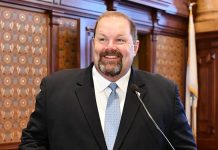



For Robert McKay, Police Accountability Is About Lives, Lost Years and Public Trust (Chicago, IL) — For Robert McKay, the consequences of police misconduct can consume much of a person’s life. A wrongful conviction can take decades to unravel. The public bill can arrive years after the damage was done.
Those consequences help explain the urgency the retired firefighter brings to his work as chair of Chicago’s 5th Police District Council. As he seeks another term, McKay wants civilian oversight to become more effective at turning residents’ concerns into action.
In an interview with The Chicagoland Journal, he described a system in which accountability must extend beyond the officer who makes an arrest. Prosecutors, elected officials and other public institutions also have responsibilities, he said, particularly when their decisions contribute to someone being wrongfully imprisoned.
By the time compensation arrives, the person has already lost something the city cannot return.
McKay’s perspective comes from years working within public safety institutions. He retired from the Chicago Fire Department as a fire investigator, a role that brought him into contact with prosecutors and the Police Department’s bomb and arson unit. He also worked as safety director at Provident Hospital of Cook County, overseeing responsibilities that included workplace standards, fire safety and security.
His current position places him on the civilian side of institutional oversight. He won a district council seat as a write-in candidate in the inaugural 2023 elections, according to official election results.
The district includes Roseland, Pullman, West Pullman, Altgeld Gardens and other Far South Side communities, where residents bring different experiences and expectations to discussions about policing.
McKay said those differences are apparent at monthly council meetings. Some residents want greater attention to neighborhood crime. Others raise concerns about police stops, searches, arrests and the use of force. He said positive experiences with officers also belong in those conversations.
For McKay, the council’s responsibility includes ensuring that complaints about police conduct receive sustained attention alongside demands for safer neighborhoods.
His involvement in those questions extends back to the beginning of his term. At a June 2023 federal consent-decree hearing, McKay introduced himself as a newly elected council member and argued that communities deprived of resources were too often left to encounter government through its police response.
That concern remains part of his thinking. During the interview, he repeatedly returned to the killing of Laquan McDonald as a defining example of why residents need meaningful ways to question police actions and demand answers.
He also connected misconduct to the city’s finances, arguing that the costs of wrongful arrests and prosecutions should figure more directly in how the responsible agencies are held accountable.
Moral dilemmas aside, the issue also has immediate financial implications. On Oct. 14, the Chicago City Council approved a $260.8 million settlement covering 17 plaintiffs whose wrongful-conviction cases involved former detective Reynaldo Guevara. The plaintiffs collectively spent more than 383 years in prison, according to reporting by the Chicago Sun-Times.
The settlement illustrates the two consequences McKay kept returning to: years taken from people’s lives and substantial public costs that follow institutional failures.
He wants oversight to help prevent those failures earlier.
Chicago’s district councils operate within a structure established by the 2021 Empowering Communities for Public Safety ordinance. Three elected members serve in each police district, holding public meetings, gathering residents’ views, working on community policing initiatives and helping nominate members of the citywide Community Commission for Public Safety and Accountability.
The citywide commission has broader responsibilities, including setting police policy, reviewing the department’s budget and participating in the selection of police leadership. Its seven members are selected through a process involving district council nominations, mayoral selection and City Council confirmation.
McKay believes elected district representatives should have a stronger voice within that arrangement. He wants concerns identified locally to reach the commission through clearer recommendations, more focused decisions and direct written communications.
He also acknowledged that the first term has involved learning how to make the structure work.
“I believe we’re growing into it,” he said.
For a second term, he wants more consistently focused meeting agendas and a more deliberate approach to identifying problems and pressing for responses.
The city’s federal police reform consent decree is another priority. McKay wants continued pressure for full compliance, particularly where training and accountability affect officers’ interactions with residents.
McKay’s scrutiny also extends to public safety spending. He supported ending Chicago’s use of ShotSpotter, saying that ShotSpotter solved no shootings, and questioned whether the money could have produced greater benefits through schools and community resources. Major expenditures, he argued, should receive regular evaluations of their results.
A 2021 city inspector general analysis found documented evidence of a gun-related criminal offense in 9.1% of 50,176 police responses to ShotSpotter alerts. The finding concerned documented outcomes of those responses. SoundThinking, the company behind the technology, has argued that its value includes alerting officers to gunfire that otherwise goes unreported and helping emergency responders reach victims quickly.
McKay wants residents to have a stronger role in examining those spending decisions and the broader practices that shape policing in their neighborhoods.
He approaches another term with a clearer understanding of the council’s structure and the work required to make it more effective.
“This is what we have to work with,” he said.
Behind the discussions of budgets, policies and institutional responsibilities is a concern he expressed in personal terms: the next harmful encounter could involve someone close to any Chicago resident.
“It could happen to a family member,” McKay said.
For Robert McKay, Police Accountability Is About Lives, Lost Years and Public Trust