



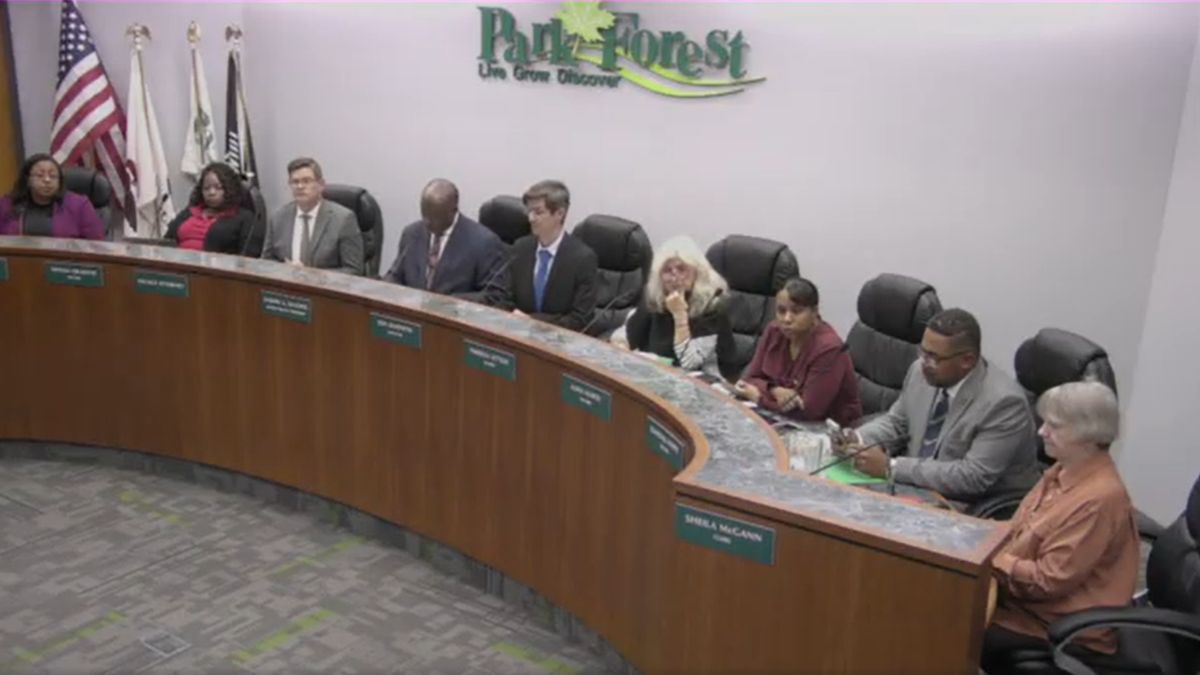
Homeowners Plead with Park Forest to Abandon Annexation Plans (Park Forest, IL) — After 30 years in her home, Priscilla Kidd told the Park Forest Village Board she still smiles when she turns into her driveway. She described raising children, welcoming grandchildren and cooking meals for the children next door.
Now 70 and living on a fixed income, she fears she may have to leave.
“How do I walk away from 30 years of my life?” Kidd asked trustees.
Her testimony was among the emotional appeals from homeowners opposing Park Forest’s latest annexation proposals, which would bring 49 parcels in unincorporated Will County into the village. Residents warned of higher taxes, questioned how village regulations would affect their properties and urged trustees to leave their neighborhoods outside municipal boundaries.
The board took no annexation vote Monday. Both ordinances received first readings and are scheduled to return for consideration Dec. 7.
For homeowners who spoke, the dispute was about whether they could afford to stay and continue using their properties as they do now.
One woman said she had spent years searching for a safe home for her children before settling on Oakhill Drive about two and a half years ago. She worried that added costs could undo the stability her family had found.
Kidd described the ties that made her own home difficult to imagine leaving, including neighbors’ children she had watched grow into young adults.
“We are simply asking you to leave me alone, to leave us alone,” she said.
Another speaker, who said his property had been annexed two weeks earlier, complained that residents had not been given an adequate opportunity for a back-and-forth discussion before the village acted. He said he wanted his property removed from Park Forest.
Village Manager Jon Kindseth defended annexation as part of a broader effort to reduce the property tax burden on existing village taxpayers. Bringing additional property into Park Forest, he said, would spread the village’s levy across a larger tax base.
“Annexations without increasing the property tax levy does not raise more revenue,” Kindseth said. “It simply broadens the base.”
He described annexation as one of several strategies that also include returning village-owned land to the tax rolls, seeking payments from tax-exempt developments and increasing revenue from sources other than property taxes.
In an earlier public explanation of the annexation effort, the village also cited its investment in infrastructure serving unincorporated properties. Officials pointed to an approximately $500,000 replacement of a deteriorating Monee Road water main expected in 2027 or 2028, arguing that properties benefiting from village infrastructure should help support it.
Trustee Randall White rejected the approach and urged his colleagues to reconsider.
“Our job is to serve the community that we represent,” White said.
He accused the village of adopting a “gangster mentality” toward people who did not want to be annexed and said the process did not reflect the Park Forest he knew.

White later reminded the audience that the decision rested with the elected board, which directs the village manager.
Questions about rural property uses remained unresolved.
Trustee John Moore asked when the village would revise its rules to accommodate newly annexed properties, including those with farm animals or businesses operated from home. He also asked what owners of properties already annexed could expect while those changes were being considered.
Kindseth said the goal was to preserve residents’ rural lifestyles. But he said the properties would initially enter Park Forest under its R-1 residential zoning designation, with a new zoning category to be developed after the annexation process was complete.
That process could include a task force of affected residents, public hearings before the Plan Commission and a recommendation to the Village Board. Kindseth said the needs of properties in the latest proposals differed from those annexed earlier, citing goats and contractors operating businesses on their land.
He did not provide a completion date for the zoning changes.
When Moore asked about suspending code enforcement in the meantime, Kindseth said the village had not advanced enforcement in areas already annexed. He said staff would work with owners to address conditions that did not conform to village rules, either by allowing time for corrections or considering those uses in the new zoning designation.
The explanation drew interruptions, followed by chants of “Drop it” from the audience.
Mayor Joseph Woods emphasized that approval was still pending.
“No, it is not a done deal,” Woods said, reminding residents that the ordinances were at first reading.
The tax debate also carried into discussion of the proposed 2026 levy, which would help fund the fiscal year beginning July 1, 2027. Finance officials outlined a plan to hold the village’s levy flat by using approximately $1.25 million in reserves. Including the library levy, the proposed total would decline about 0.59%, or $135,133.
Officials said higher-than-expected police and fire pension contributions would require adjustments elsewhere in the budget. The levy remained under consideration; a flat village levy describes the total amount sought through that levy, rather than a guarantee that each household’s tax bill will remain unchanged.
In other business, trustees approved a preliminary redevelopment plan for the former St. Irenaeus campus at 78 Cherry St. The Women’s Empowerment Center and Network plans a phased project with transitional housing for pregnant and parenting young people, child care and community services. A companion agreement establishes payments in lieu of property taxes, rising from $5,000 to $50,000 annually by 2032, with subsequent increases tied to inflation and capped at 2%.
The board also approved selling 29 North St. to Homewood Disposal for $32,274. The company must demolish a vacant car wash and redevelop the property. Kindseth said shifting demolition responsibility to the buyer would spare the village an estimated $200,000 expense.
Public works approvals included a $49,000 downtown snow and ice removal contract with Diaz Group; up to $57,996.95 for storm sewer cleaning and camera inspections following flooding; and a letter of intent to purchase two snowplow trucks for $564,600 for fiscal year 2027-28. White voted against the truck proposal.
Trustees approved $26,000 for two rounds of unlimited leaf collection for single-family homes on Nov. 24 and Dec. 1. Leaves placed in 33-gallon biodegradable paper bags will not require yard waste stickers. Co-ops and commercial accounts are excluded.
The board also authorized an agreement with Will County for a radar speed display, part of a five-sign program supported by a $10,000 ComEd grant. A proposed special-use permit for a club, lodge or hall at 300 Victory Drive was tabled.
Homeowners Plead with Park Forest to Abandon Annexation Plans