



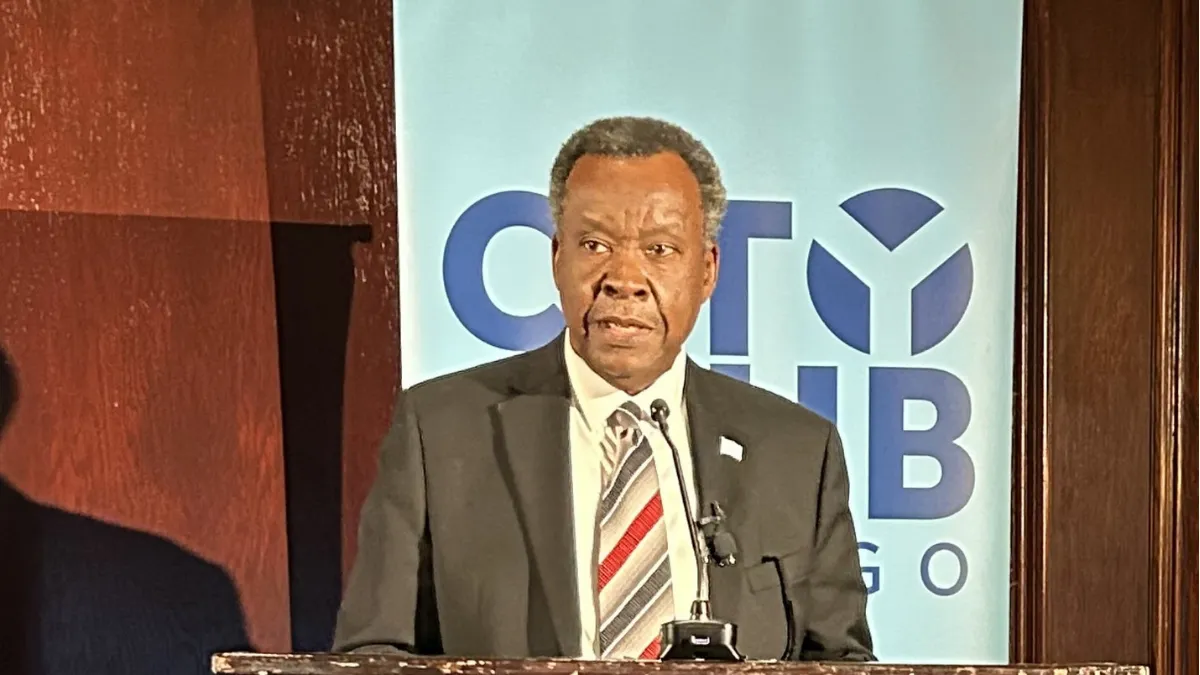
Wilson Pitches $1 Billion Savings Plan Amid Chicago Budget Debate (Chicago, IL) — Mayoral candidate Dr. Willie Wilson is proposing a sweeping review of city spending, contracts and public property, arguing that Chicago can save $1 billion annually and eventually produce a $500 million operating surplus without raising taxes or reducing essential services.
Wilson outlined the proposal during a Nov. 10 appearance before the City Club of Chicago. His financial and economic development blueprint, covering 2027 through 2031, combines government restructuring with plans to develop vacant land, expand job training and attract businesses.
The proposal enters a budget debate already centered on how much Chicago can achieve through spending reductions and how much additional revenue it needs. Mayor Brandon Johnson’s proposed 2027 budget seeks to close an $882.4 million projected gap through a combination of savings, revenue measures and other financing decisions, according to the administration.
Wilson’s savings and surplus figures remain goals rather than independently established results. His blueprint acknowledges that major estimates require verification, and achieving a surplus would require enough recurring savings and revenue to cover both existing obligations and the costs of his proposed initiatives.
“We need to stop asking taxpayers for more money and start demanding more accountability for the money the government already collects,” Wilson said in a statement announcing the plan.
A central element is a department-by-department examination of spending. Wilson proposes independent operational audits, fewer management layers, consolidation of overlapping administrative functions and zero-based budgeting, which would require departments to justify expenditures instead of relying primarily on the previous year’s spending levels.
His published blueprint sets a preliminary target of $225 million in annual organizational savings, subject to independent verification. It also calls for reviewing city buildings, leases, vehicles and administrative vacancies.
Wilson cited a city-commissioned analysis by EY, formerly Ernst & Young, that identified between $530 million and nearly $1.4 billion in potential savings and revenue opportunities. That range, however, should not be read as a finding that Chicago can immediately eliminate an equivalent amount of annual waste.
The options include spending reductions and additional revenue, with some benefits developing over several years. The Civic Federation’s review of the EY report noted that real estate benefits were estimated over a decade and that a comprehensive overhaul of purchasing practices could take three to five years. Other recommendations would require negotiations with organized labor.
Johnson’s administration also says it is pursuing efficiencies. Its 2027 proposal identifies nearly $120 million in savings and cost reductions through measures including real estate consolidation, fleet modernization and organizational changes. The Civic Federation has questioned how much of that total represents lasting efficiencies, rather than shifting expenses between funds or temporarily holding positions vacant.

Wilson rejects a corporate head tax and proposes expanding the tax base through business investment, neighborhood development and employment. Johnson’s budget proposal includes a tax tied to employment at large companies, making the question of how to raise revenue a point of disagreement between the two approaches.
Wilson’s development agenda calls for putting more than 10,000 city-owned vacant lots to productive use through housing, commercial projects and other investment. He also proposes making permits and licensing easier to navigate and expanding opportunities for Chicago businesses to compete for public contracts.
A workforce initiative would aim to train 5,000 residents annually and place 70 percent of participants in jobs. The blueprint assigns a preliminary annual budget of $30 million to that effort. Those targets would need to translate into sustained employment and additional economic activity to support the broader financial plan.
On public safety, Wilson proposes evaluating a phased expansion of 1,000 police officers while reviewing deployment and overtime. Whether additional hiring would reduce overall costs would depend on staffing expenses and any corresponding reduction in overtime spending; the proposal does not establish that outcome.
His education proposals include reviewing severely under-enrolled schools, administrative spending and building use in cooperation with the Chicago Board of Education and affected communities. The published plan raises consolidation or repurposing of underused facilities while pledging to protect classroom instruction and student services.
Wilson also calls for maintaining required pension contributions, strengthening financial oversight and seeking additional state support for teacher pensions. Other priorities include faster replacement of lead water service lines, improved collection of reimbursements owed to city departments and an examination of options to keep the Chicago Bears in the city.
The Bears component calls for an independent financial analysis before committing public resources.
Taken together, the blueprint lays out a substantial reworking of city operations alongside new investments. Turning those priorities into a balanced spending plan would require verified estimates, implementation schedules and cooperation from the City Council, labor organizations, school officials and other levels of government. Wilson acknowledges that his headline financial targets depend on that further work.
Wilson Pitches $1 Billion Savings Plan Amid Chicago Budget Debate