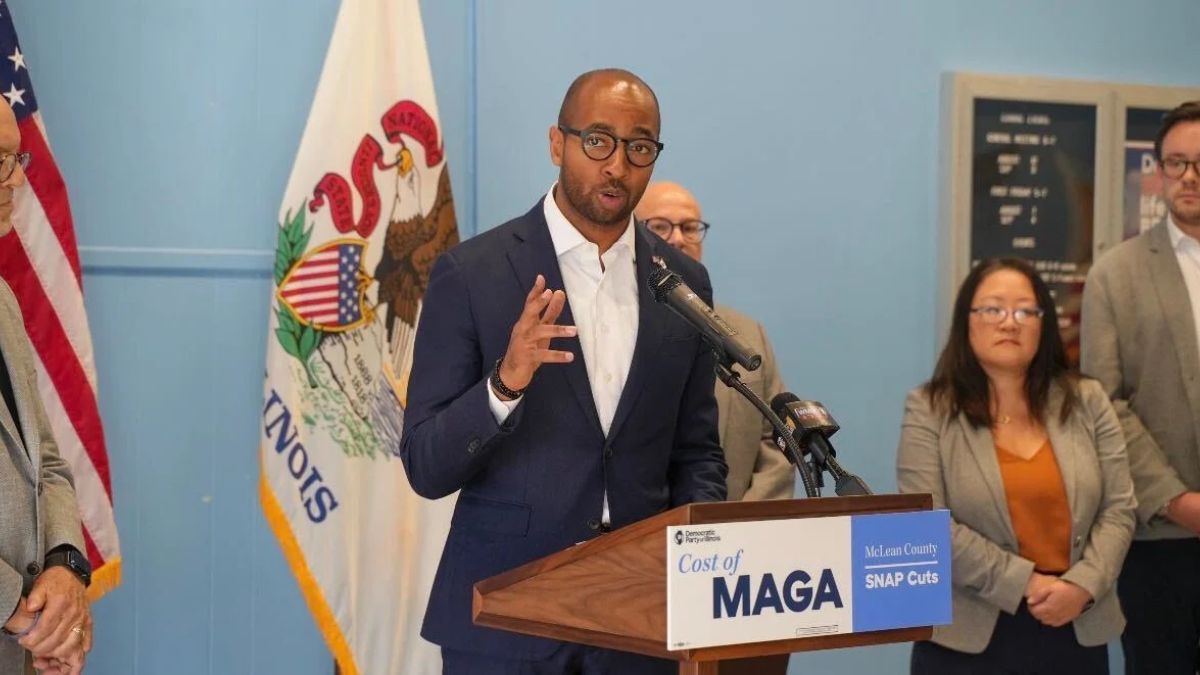
Illinois Democrats Launch ‘Cost of MAGA’ Tour in Bloomington, Focus on Federal SNAP Changes (Bloomington, IL) — Illinois Democrats brought their criticism of recent federal changes to food assistance programs to Bloomington this week, launching a statewide “Cost of MAGA” press tour focused on the financial impact they say new federal policies will have on families and state taxpayers.
Democratic lieutenant governor candidate Christian Mitchell joined state lawmakers and McLean County Democratic leaders Monday to highlight changes to the Supplemental Nutrition Assistance Program, commonly known as SNAP.
The event came just days before a major shift in how the program is financed.
Beginning Oct. 1, states will be responsible for 75% of the administrative cost of operating SNAP, up from the previous 50% share. Illinois budget officials estimate that change will cost the state approximately $80 million more each year.
The change was included in the federal budget law signed in 2025, commonly referred to as H.R. 1 or Public Law 119-21. The law also made significant changes to SNAP eligibility and work requirements and will eventually require some states to contribute toward the cost of SNAP benefits themselves based on payment error rates.
Illinois officials have estimated that more than 360,000 residents could be directly affected by SNAP work requirements and eligibility changes and potentially lose benefits if they no longer meet federal requirements.
Democrats used Monday’s event to frame those changes as part of a broader political argument against President Donald Trump and congressional Republicans ahead of the November election.
“Thanks to quick work by Illinois Democrats, families in McLean will have access to support and resources and be able to afford their groceries on October 1,” Mitchell said.
Mitchell, a former state representative and former deputy governor under Gov. JB Pritzker, is Pritzker’s running mate in the Nov. 3 general election. State Board of Elections records list Mitchell as the Democratic candidate for lieutenant governor.
“Trump handed Illinois taxpayers a bill the federal government used to pay,” Mitchell said, while criticizing the tax provisions included in the broader federal legislation.
Illinois lawmakers have responded with several state-funded measures designed to reduce the immediate effect on households losing or seeing reductions in food assistance.
Among them is the Families Receiving Emergency Support for Hunger, or FRESH, program. Under state law enacted in June, qualifying individuals who lose or have their SNAP benefits reduced because they fail to meet federal work requirements can receive a one-time $400 payment.
The benefit is distributed automatically through an Electronic Benefit Transfer card for eligible recipients, subject to available state funding.
Democrats at Monday’s event argued that SNAP reductions would have consequences extending beyond individual households. Patrick Cortesi, Democratic State Central Committeeman and chairman of the McLean County Democratic Party, said fewer SNAP dollars also mean less money circulating through grocery stores, agricultural producers and local businesses.
“The federal changes to SNAP and other budget cuts aren’t just numbers on a spreadsheet,” Cortesi said. “They mean fewer grocery dollars being spent in our communities.”
Cortesi said food banks, churches and nonprofit organizations could also face additional pressure as families who lose government benefits turn to community organizations for assistance.
State Sen. Dave Koehler, D-Peoria, said lawmakers attempted to prepare for that possibility while drafting the state budget.
“When federal cuts threaten to pull the rug out from under Illinois families relying on SNAP, the General Assembly steps up,” Koehler said.
The increased administrative burden is real regardless of the political debate surrounding the law. Illinois’ FY2027 budget documents estimate the state will need to absorb roughly $80 million annually in additional SNAP administrative expenses beginning Oct. 1.
The federal law also expanded the population subject to SNAP work requirements. Illinois officials have said the changes more than double the number of state recipients who may have to satisfy those requirements or qualify for an exemption.
State Rep. Sharon Chung, D-Bloomington, characterized the federal changes as particularly harmful to lower-income residents.
“The Trump Administration’s cuts to SNAP are heartless, and they hurt those who need help the most,” Chung said. “In Springfield, we’re doing the work to combat the worst of this president’s cruel policies.”
Republicans who supported the federal legislation have generally argued that tighter eligibility rules and expanded work requirements are intended to encourage employment, reduce improper payments and restrain federal spending. The Illinois Democrats participating in Monday’s event rejected that framing, arguing that the practical effect will instead be higher costs for states and fewer food assistance benefits for some residents.
Additional changes are still coming. Beginning in federal fiscal year 2028, states could also be required to pay part of the actual cost of SNAP benefits based on their payment error rates, a significant departure from the longstanding structure under which the federal government paid the full cost of food benefits while sharing administrative expenses with states.
McLean County Board Chair Elizabeth Johnston said the debate ultimately affects whether residents can meet basic needs.
“The fabric of our society is strongest when basic needs are met in food, housing, and safety,” Johnston said.
Joshua Crockett, a Democratic candidate for McLean County clerk, also participated in the event, saying the issue demonstrates the connection between federal policy decisions and local governments.
“Federal SNAP cuts hit close to home right here in McLean County,” Crockett said, citing working families, seniors and children among those who could be affected.
The Bloomington appearance is the first stop in what the Democratic Party of Illinois says will be a broader press tour highlighting the consequences of federal Republican policies.
For Illinois, the immediate fiscal impact arrives Wednesday, when the state’s share of SNAP administrative expenses increases from 50% to 75%.
The longer-term impact will depend in part on how many Illinois residents remain eligible under the new requirements, how effectively the state administers exemptions and work-verification rules, and how much additional state funding lawmakers are ultimately willing to commit to offset changes made at the federal level.
Illinois Democrats Launch ‘Cost of MAGA’ Tour in Bloomington, Focus on Federal SNAP Changes