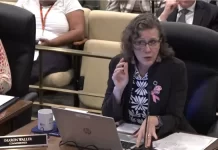




Cook County Budget Relies on Reserves as Officials Confront Lasting Shortfalls (Chicago, IL) — Cook County’s proposed budget would spare residents a tax increase and avoid employee layoffs next year by drawing on savings accumulated during better financial times. At an Oct. 27 hearing, finance officials explained both the value of that cushion and the limits of relying on it.
Board President Toni Preckwinkle’s $9.69 billion spending proposal closes a preliminary $550.7 million gap, preserving core services while the county contends with restrictions on transportation tax revenue, changes in federal health care policy and rising personnel costs. The plan is 4.2% smaller than the current year’s budget.
Yet the presentation to the County Board’s Finance Committee also showed that balancing the 2027 budget would leave substantial work for the years that follow. Some of the money supporting next year’s operations can be spent only once, and officials’ projections show ongoing expenses growing faster than revenues.
For residents, the stakes extend beyond the size of a budget deficit. They include whether the county’s health system can absorb more uninsured patients, whether public defenders have enough staff and whether community programs launched with pandemic relief money can continue after that funding ends.
Chief Financial Officer Angela Manning-Hardimon described the administration’s strategy as “a stopgap approach.” Using reserves now, she said, would give the county time to assess federal policy changes, pending litigation and revenue trends before developing longer-term solutions.
Deputy Chief Financial Officer Dean Constantinou presented a warning about the consequences of leaving the underlying imbalance unresolved: Under the county’s forecast, its unassigned general fund balance would fall below the minimum set by county policy in 2028 and turn negative in 2029 if revenues and spending were not addressed, which gave commissioners a measure of how quickly the room to maneuver could narrow.
On the general fund side, officials said restrictions associated with the roadbuilders litigation prevent the county from using nearly $258 million in transportation-related taxes as it previously had. Those revenues had supported public safety expenses that the county connected to enforcing traffic and transportation laws.
The taxes are still being collected, Budget Director Kanako Ishida Musselwhite explained, but the money is being placed in a separate fund. The immediate problem is that those collections are unavailable to support the operations for which the county previously budgeted them.
When Commissioner Michael Scott Jr. asked what would happen to the accumulating money if the litigation did not end in the county’s favor, finance officials deferred the question to legal counsel. The exchange left an important uncertainty unresolved: how the county would finance those recurring expenses if it could not resume using that revenue.
Cook County Health faces a different problem with a similar consequence for the budget. Officials expect federal Medicaid changes to reduce insurance enrollment while increasing the number of people who need care without coverage to pay for it.
The proposed $4.7 billion health enterprise budget anticipates an additional $100 million in charity care. County budget materials put the projected total at $485 million in 2027. The administration proposes directing an additional $40 million in existing county property tax revenue to the health system, bringing its county support to $208 million.
The health system’s financial plan also depends on better billing and collections, lower use of outside agency staff and reductions in purchased services. Officials said overall health system staffing would remain flat.
Commissioner Scott Britton urged other hospital systems to assume more responsibility for uninsured patients, reflecting a broader concern about how much of the region’s safety-net burden the county can continue to carry.
The general fund plan includes about $76 million in net spending reductions compared with the preliminary forecast, along with $93 million in improved revenue projections since June. Savings include tighter payroll and overtime controls, deferred technology projects and reductions in other spending.
The reserves used to balance next year’s budget come with tradeoffs of their own.
The proposal transfers $88 million in accumulated interest from American Rescue Plan Act funds to the general fund. It also redirects $61.2 million in county reserves previously set aside to sustain pandemic-era programs in later years and uses $18 million from a $200 million pension stabilization fund. Other adjustments shift resources associated with debt service toward essential operations.
Officials said $52.6 million would remain available in 2027 for a dozen programs transitioning from federal relief funding. About $45 million would remain for those programs across 2028 through 2030.
That preserves next year’s commitments while leaving substantially less money for their continuation afterward. Any decision about their future would have to account for that smaller pool.
Staffing decisions prompted a more pointed discussion about who bears the effects of restraint.
The proposal reduces general fund staffing by about 50.7 full-time-equivalent positions through vacancies and positions associated with long-term leaves, officials said. The administration also rejected requests for additional positions rather than adding ongoing payroll obligations.
Commissioner Jessica Vásquez questioned the effect of a two-position reduction in the public defender’s office, saying even a small decrease could matter in an office serving people with limited resources.
“Losing two positions within that office has a huge impact,” she said.
Ishida Musselwhite responded that the change reflected an arrangement agreed to by the public defender’s office to make two position allocations available to the county’s human resources bureau in connection with shifting responsibilities. She also acknowledged that the public defender had requested more positions than the proposal funded.
Vásquez maintained that the county should consider the unequal effects of reductions across offices with different workloads and resources. Her concern remained even after the explanation of the staffing arrangement.
Commissioner Donna Miller raised a related question about community violence intervention funding, asking why projected allocations declined after 2027. Ishida Musselwhite said the larger 2027 amount included anticipated carryover from the current year as well as a new $20 million commitment. The later-year figures assumed that carryover had been spent, alongside continued annual commitments of $20 million.
Another possible source of relief remained uncertain. Finance officials said Chicago’s proposed budget could provide approximately $9.6 million in additional tax increment financing surplus revenue to the county. The amount had not been finalized, and Manning-Hardimon said the administration wanted to replenish reserves supporting former ARPA programs rather than use a temporary windfall to add permanent employees.
No final budget vote occurred during the overview. The county has scheduled a vote on the executive budget recommendation for Nov. 19.
By then, commissioners will have to weigh a proposal that protects services next year while spending some of the resources available for the years afterward. The hearing made clear that the county’s savings can help it through an immediate squeeze. Decisions about how to sustain those services will outlast this budget cycle.
Cook County Budget Relies on Reserves as Officials Confront Lasting Shortfalls