


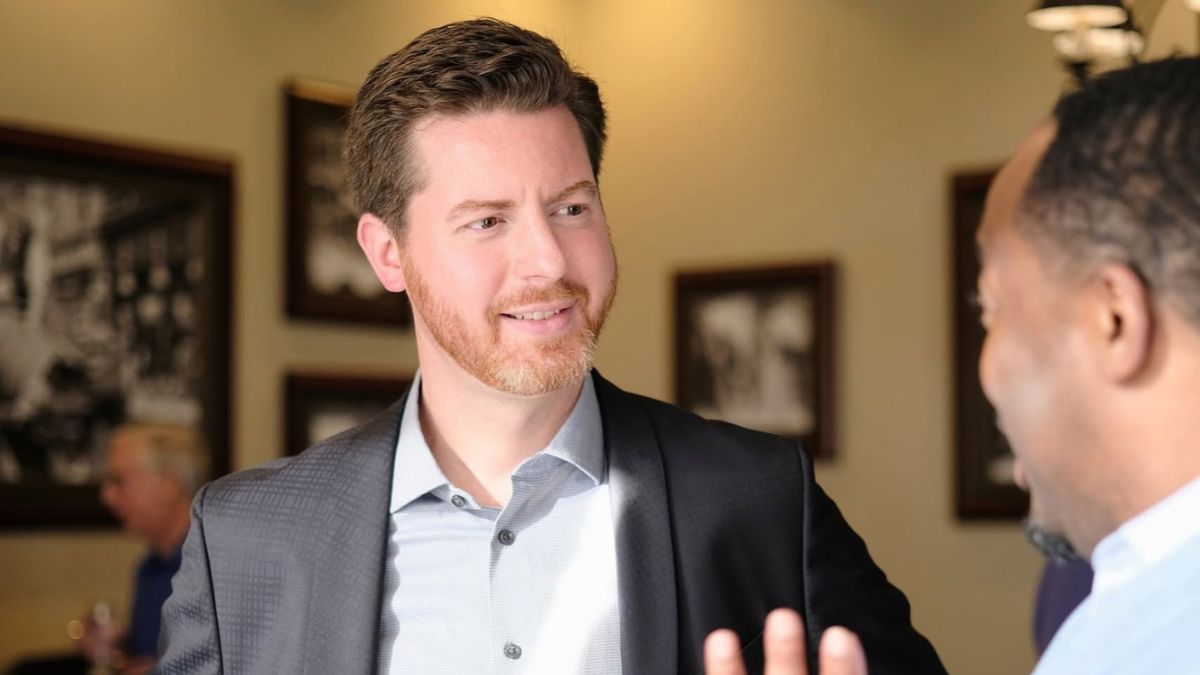
Governor Candidate Collin Corbett Makes an Independent Bet on Illinois’ ‘Politically Homeless’ Voters (Chicago, IL) — Collin Corbett spent two decades helping other people win elections. Now that he is running for governor himself, he is unusually direct about the possibility that he will lose.
“I’m well aware of the odds of us winning this election,” Corbett said in an interview with The Chicagoland Journal. But even as he campaigns to unseat Gov. JB Pritzker, he is working toward something he believes could outlast this race: an independent political movement with enough support to make both major parties reconsider how they govern.
“Most of us feel politically homeless,” he said. “And so what we’re trying to create is a mainstream independent space for everyday people so that we feel like we can actually be represented and have a voice in our politics.”
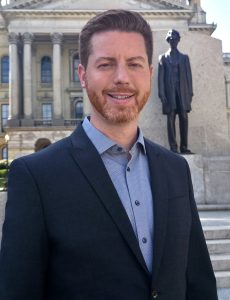
Click to enlarge.
Corbett is the third option in a governor’s race otherwise defined by familiar opponents. Pritzker, a Democrat, is seeking a third term against Republican Darren Bailey, the former state senator he defeated in 2022. Corbett, a former Republican political consultant, is asking voters to consider an alternative to that rematch in the Nov. 3 election.
His pitch combines a critique of partisan politics with proposals to change how Illinois funds schools, supports local governments and taxes everyday purchases. Yet the interview also revealed the central challenge of his candidacy: turning dissatisfaction with the political system into a workable governing program, and an organization capable of surviving Election Day.
An Insider’s Break With the Parties
Corbett, 40, has never held elected office. His experience comes from the business of politics: founding consulting and communications companies, recruiting candidates and helping others navigate campaigns. The Palatine resident founded Cor Strategies, a firm whose work has included Republican campaigns.
His campaign biography describes a less conventional path into that profession. He says he could not afford college and started his first business from a closet in his apartment. He and his wife, Abbey, live in Palatine with their young son, Theodore Rex. Those experiences form part of his campaign’s presentation of a candidate familiar with the financial pressures he now talks about on the trail.
But his years inside Republican politics also raise an obvious question: How much responsibility does a political consultant bear for the system he now wants to change?
“We all share a hand in what led us to this point,” Corbett said when asked. He defended his companies’ selectivity in choosing clients, saying he had tried to support people who entered public service for the right reasons. Eventually, he concluded that working within a party was no longer the best way for him to produce change.
“I couldn’t fix it from within,” he said. “Now, I’m going to focus on fixing it from outside that broken system.”
Corbett identified immigration enforcement raids in Chicago and the surrounding suburbs as a turning point. The raids, and the politics around them, convinced him that neither party was adequately prioritizing families and communities, he said. His broader objection is to a system that rewards defeating an opponent more consistently than solving a problem.
His independent candidacy does not erase his political history, but his positions do not fit neatly within the Republican platform. He has publicly supported abortion rights and marriage equality, arguing that government should stay out of those personal decisions. His running mate, Carolyn Schofield, is a former Republican McHenry County Board member who previously ran for lieutenant governor in 2022.
Property-Tax Relief Starts in Springfield, He Says
Corbett does not describe Pritzker’s tenure as an unqualified failure.
He compared Illinois’ financial condition when Pritzker took office to a patient arriving in an emergency room. Pritzker, he said, helped stabilize that patient. The problem, in Corbett’s telling, is that stabilization has not resolved the conditions that caused the crisis.
Illinois’ credit standing has improved during Pritzker’s administration; WTTW reported this week that the state has received 12 credit-rating upgrades since his election. Corbett’s argument is that better state finances have not translated into sufficient relief for households facing housing costs, property taxes and other expenses.
Property taxes are central to that argument.
Asked specifically about homeowners in Cook County and the south suburbs, Corbett rejected the idea that property-tax relief is solely a local responsibility. He argued that when the state provides inadequate school funding or imposes requirements without paying for them, local officials are left to fill the gap.
His proposed response begins with freezing discretionary state spending, examining whether programs justify their costs and reducing unfunded mandates. He also wants to preserve money that becomes available as certain bonds are retired in 2030 and 2033, rather than committing those dollars to unrelated spending.
Corbett would direct additional resources toward education, legacy pension debt and the Local Government Distributive Fund, which supports municipalities and counties. Crucially, he said, increased aid would be paired with incentives for local taxing bodies to pass savings along to residents through lower property taxes.
That particular distinction matters to his proposal: More money for a school district or municipality would not, by itself, guarantee a smaller tax bill. His approach depends on linking additional state support to reductions at the local level.
It is also a long-term proposal, not a promise of an immediate fix. His published property-tax plan acknowledges that resolving the underlying problems would take more than a decade.
A Different Sales Tax, With Details Still to Come
Another major component of Corbett’s affordability agenda would change what Illinois taxes when people spend money.
He wants to remove sales taxes from everyday necessities, including diapers, baby formula, medicines and school supplies, and broaden the tax base to include higher-end services. His argument is that a system focused heavily on goods places too much pressure on families buying things they cannot reasonably do without.
Pressed on which services would be taxed and how small businesses would be protected, Corbett acknowledged that the proposal is not yet a finished implementation plan.
“We’ve got work to do to figure out exactly how to implement this. And I will readily admit it,” he said. “Our idea is a concept, but it’s one that has been thoroughly vetted by policy shops both left of center and right of center.”
He did not identify a final list of taxable services or quantify the revenue the change would generate during the interview. He said protecting small businesses from the costs of implementing a new system would be a priority.
The existing tax structure adds another complication. Illinois eliminated its statewide 1% grocery tax on Jan. 1, 2026, but authorized municipalities and counties to impose replacement grocery taxes. Regional transit taxes on groceries also remained. Eliminating taxes on those purchases more broadly would therefore require addressing revenue that supports local governments and transportation, not simply removing a single state tax.
That is one of the practical questions behind Corbett’s affordability agenda: how to provide meaningful relief at the checkout counter without creating new funding pressures elsewhere.
Local Control and a Different Approach to Business
When the conversation turned to historically underserved communities on Chicago’s South and West sides and in southern Cook County, Corbett emphasized local decision-making rather than a uniform statewide prescription.
He said Springfield should provide resources and support while allowing communities greater room to determine their own priorities. He also drew a connection between struggling south suburban municipalities and rural communities that feel overlooked by state government.
“Springfield doesn’t know better than you do,” he said. “So, I want to work with our local leaders.”
That preference for local control carries into his economic agenda. Corbett argued that large companies can absorb regulatory requirements through legal departments and specialized staff, while smaller businesses often rely on an owner or family member to handle the same responsibilities. He wants to reduce those burdens and redirect support away from large corporate incentive packages toward small and midsize businesses, manufacturers and family farms.
He frames that approach as a workforce policy as much as a business policy. The purpose, he said, is to create better-paying jobs and increase wages.
“I’m pro-business because I’m pro-worker,” Corbett said.
What Would Success Look Like?
Corbett’s ambitions extend beyond his own election, but he is not presenting the campaign solely as a symbolic exercise.
In an earlier interview with The Daily Illini, he said he was aiming for roughly 15% of the vote, while acknowledging that reaching that target was unlikely. The larger objective was to attract enough support that both parties would have to engage with independent voters and candidates in future elections.
There is evidence of a substantial constituency uncomfortable with party labels. Gallup found that a record 45% of U.S. adults identified as independents in 2025. But most of those independents still leaned toward one of the two major parties. Identifying as independent is not necessarily the same as being willing to vote for an independent candidate, a distinction that complicates Corbett’s effort to turn political frustration into electoral support.
Asked how he would persuade an established-party legislature to support reform, Corbett focused on changing lawmakers’ political incentives. An organized independent constituency, he argued, could support officials who make decisions that anger party leaders or influential interests. That would give those officials somewhere to turn beyond the organizations that currently help determine their political futures.
It is a theory of political change more than a detailed legislative strategy. Its success would depend not only on Corbett’s vote total, but on whether the people drawn to his campaign remain engaged afterward.
For voters worried that supporting him would waste their vote, Corbett offered an argument about the choices they might have in the next election.
“Send a message that you’re sick and tired of this broken political system,” he said. “Send a message that you want better candidates next time.” He also urged people to participate regardless of whether they supported him, pointing to other races on the ballot that deserve attention.
For now, Corbett is pursuing two goals at once: becoming governor and building something that could matter even if he does not.
“And the goal is something lasting,” he said, “something long-term that will finally fix our broken politics.”
Governor Candidate Collin Corbett Makes an Independent Bet on Illinois’ ‘Politically Homeless’ Voters